Demystifying the Semiconductor Value Chain: Advanced Packaging
My uncle Nelson Huang ran Golden Wok for over a decade. He could skin a chicken in under a minute, and he knew which regulars wanted extra chili oil without asking. Until recently, he believed the hardest part of the restaurant business was promoting his food.
Then, eighteen months ago, a delivery app put Golden Wok on its front page when a food influencer filmed herself cracking open his Beggar's chicken — a whole bird stuffed with mushrooms and seasoned rice, wrapped in lotus leaves, sealed in clay. To prepare the dish, he had to bake the entire thing for six hours until the shell was hard enough to be broken at the table with a small mallet. "Genuinely life-altering," she told four million people. Orders quadrupled in a month, and everyone wanted the chicken.

After going viral, my uncle did everything he could to keep up with all the eager foodies reserving a spot to try the chicken. He raised prices, he hired, he prepped more and stayed open later. And that's when he learned the real lesson of running his restaurant: You can ramp up your own kitchen however you want. You can't ramp up your suppliers. Over the next year and a half, that one dish failed him three times, and never once because of the chicken.
The Lotus Leaf
The Beggar's chicken has a maximum size, and it isn't set in the kitchen. The lotus sets it. A leaf grows as big as a leaf grows, and it needs to wrap the chicken perfectly. If too big, all the aromatics escape, and the chicken bakes dry; if too small, the stuffing leaks out and the mushrooms burn in the oven. If no vendors at the farmer's market sell lotus leaves with the right size, Uncle Nelson still has to find a way to serve the dish. So at banquets, when big spending regulars request extra chicken, he wraps two together in an oversized leaf, and serves them side by side as one platter. To keep the seams from tearing under the extra weight, Uncle Nelson has to enlist his Taiwanese cousins, who run a catering crew across town and know the double-fold that holds. His own line is already maxed out just keeping up with the singles; customers who just want soup dumplings are turned away.
Three thousand miles away, a man in a leather jacket has the same problem. Nvidia's lotus leaf is the reticle, which limits the largest pattern a lithography machine can print onto a wafer. So Nvidia cannot design a GPU die exceeding the 26 mm × 33 mm exposure field. To get past the limit, Blackwell ships as two maximum-size dies served in one package, linked tightly together to behave as a single chip.
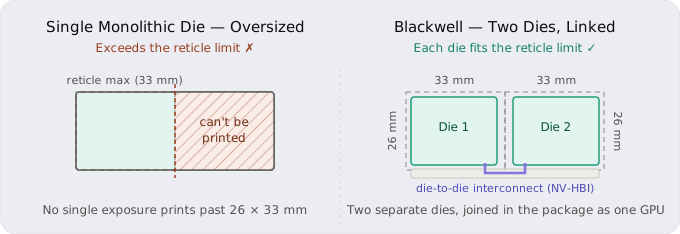
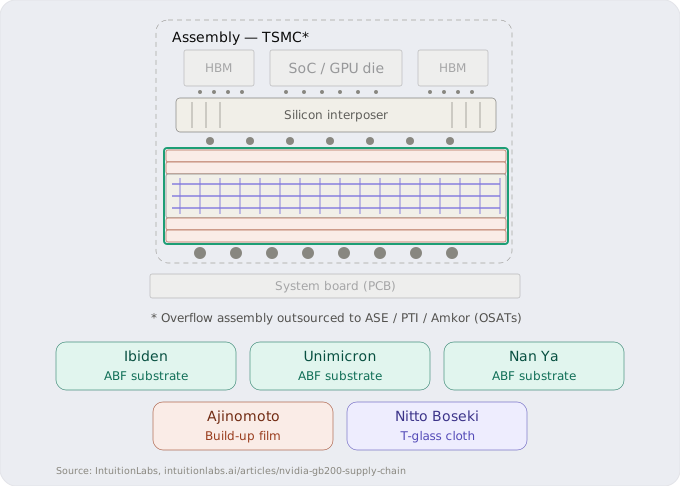
To manufacture Blackwell, TSMC's advanced packaging lines hit the same capacity ceiling as the lines at Golden Wok. Only so many double-die packages can be bonded through CoWoS each month, and the hyperscalers' datacenter build-out has all the assembly lines backed up. To keep all the AI customers happy, TSMC keeps the high-margin chip-to-wafer bonding in-house and offloads overflow work to fellow Taiwanese assembly houses, ASE, PTI, and U.S.-based Amkor for substrate-assembly, testing, and legacy-packaging steps. However, gamers who just want an RTX 50-series card for their new PC are turned away. While GeForce dies are monolithic and don't need any advanced packaging, they still compete for TSMC's 5nm-class wafer capacity as Nvidia's enterprise AI silicon. With datacenter parts generating an order of magnitude more revenue per die, Nvidia allocates the shared upstream capacity to AI accelerators first.
From here, the kitchen lines and the packaging lines fail in parallel, layer by layer:
The Seasoning
Then came the first call. My uncle's distributor said the MSG in the stuffing was being rationed, like wartime butter. Some new-age diet fad had turned sodium into the enemy, and every company on earth now needed MSG to promote its low-sodium wellness branding. The MSG producers said their expansion would not complete for another two years. Without any alternatives, Uncle Nelson bought what he could and reformulated around the rest.
Ajinomoto, the company famous for creating MSG, makes the insulating film laminated between every sheet of copper wiring, seasoning the layers of the substrate since the Pentium III. The substrate is the miniature circuit board inside every processor, built one build-up layer at a time — copper then film, then copper again — stacked on both sides of a rigid core woven with glass cloth. Before Intel's Pentium III, processors used messy liquid insulating inks, screen-printed, dried, and polished one coat at a time. Ajinomoto handed factories a ready-made sheet of film instead, clean enough for lasers to drill the microscopic holes that connect one layer of wiring to the next. This substitution made it possible to build substrates through a stack-and-repeat process.
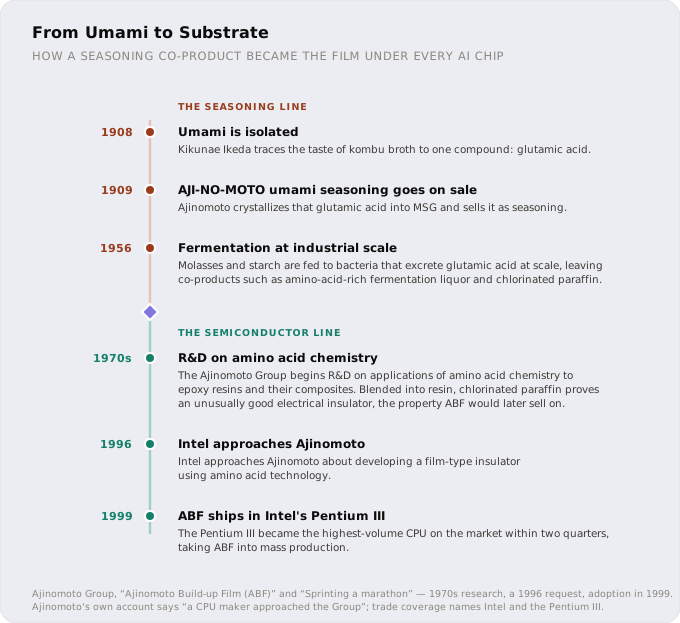
Like Scotch tape, the Ajinomoto Build-Up Film (ABF) became the name for an entire category. It is the foundation of semiconductor chip packages, and today the entire AI build-out funnels through it. Blackwell, AMD's MI400, and every hyperscaler's custom ASIC all stand on the same layers of insulation film. No one has found a qualified substitute yet. Neither, for what it's worth, has my uncle Nelson. The two Huangs share the same supplier, and Ajinomoto seasons both the stuffing and the substrate.
The Clay
The second failure was the clay shortage. The food-safe casing blend comes from exactly three regional suppliers, and every restaurant chasing the same viral dish was calling all three. So Uncle Nelson did something ten years of thin margins taught him to never do: he prepaid. After maxing out six credit cards and enrolling in seven buy now, pay later plans, he advanced his clay suppliers money to produce more clay just to guarantee his allocation.
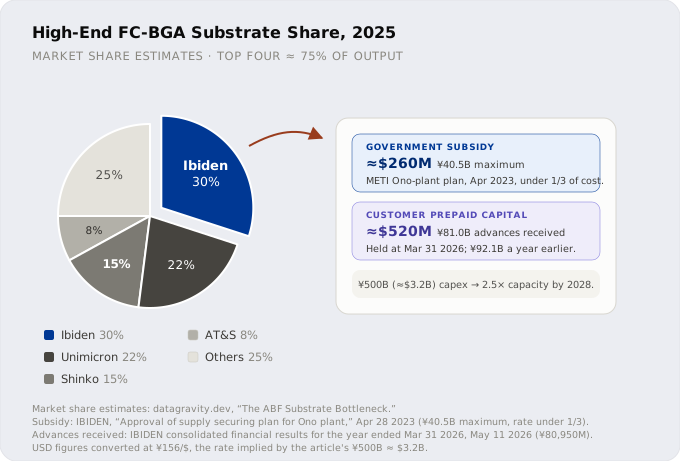
Jensen's clay is the build-up itself, soft ABF layers pressed and cured over a rigid fiberglass core until they harden into a finished slab. Copper traces run through the whole stack, wiring the chiplets down to the motherboard below. For most of the chip industry's history, the substrate was invisible plumbing; a 2015 CPU needed just a few ABF layers in a ~40mm package that cost about $50. The package shipped within weeks from suppliers nobody has heard of. Blackwell blew up that package. Its two huge dies and eight memory stacks are wired together on a single giant substrate, consuming three to four times as much substrate material as the ordinary CPU. To secure enough packaging capacity, Nvidia reportedly fronted roughly half of the cost of expansion projects at Ibiden and Unimicron. But volume is only half the challenge. Each ABF substrate must also be tailored to the electrical and mechanical demands of a specific chip module to run AI workloads at scale. Chip and substrate makers now co-design each generation of AI packages, and must coordinate their capacity and R&D roadmaps in lockstep. That up-front capital and deep coordination have concentrated the high-end substrate market around a handful of incumbents.
The Rice Straws
The third call was about the rice straws, delayed and with no arrival date. Of all things, it was the straw that nearly broke my uncle's back. Uncle always said the secret to a good Beggar's chicken was a sturdy pack of straws. He followed the tradition his grandfather taught him, where the straws tied the lotus-wrapped bird, tightening every seam while he packed mud all over to make a smooth grey egg. The hidden fiber kept the clay from cracking as it shrank in the heat.
Nvidia's Blackwell architecture relies on the same principle. Inside the substrate beneath each chip, woven glass fiber, specifically T-glass, holds brittle laminate together through the heat of assembly and the stress of thermal cycling. The cloth sits at the core, reinforcing the very material that encases it.
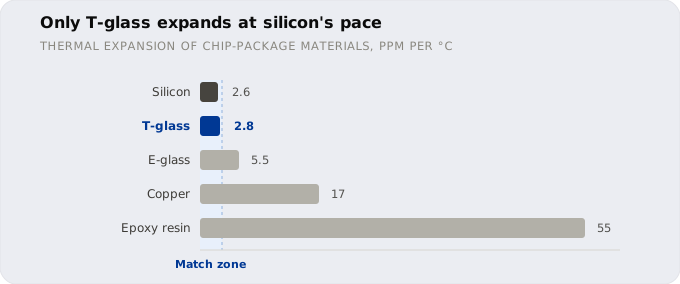
The most advanced cloth comes almost exclusively from a single Japanese textile mill, Nitto Boseki. When AI demand surged, there wasn't enough fabric to go around. Prices jumped, and orders backed up for over a year. Procurement teams from billion-dollar firms all flew to Japan to plead for allocation.
The Bullwhip Effect
After running the restaurant for over ten years, my uncle had to close down Golden Wok. The viral rush worked its way backward through the supply chain. Suppliers raised their bulk minimums to justify investments needed for new production, and by the time the order reached the straw weaver, a month of viral demand looked like the new normal. Uncle Nelson prepaid at the top of that curve. Then the video cycled out of everyone’s feed, and the delivery app’s orders shrank to a quarter of the peak. But the clay and straws Uncle Nelson had preordered kept arriving on schedule, and he wasn’t able to repurpose the materials for another dish. Only then did the other half of the bullwhip show up, the half nobody warned him about.
Investors see the same risk in the capital pouring into AI infrastructure and do not want to be caught on the back half of the bullwhip. Every quarter, critics trace how many Blackwells were bought with Nvidia's own money. Where are the profits to justify the spending?
On the suppliers' end of the whip, Nvidia sees a different problem. When the AI boom took off, it first had to convince its suppliers to scale up so there would be a build-out at all. For more GPUs to exist, Ibiden, Ajinomoto, and Nitto Boseki must all expand capacity, adjusting to a wave of AI demand they have no way to forecast. And they cannot rely on the volatile signals coming up from the demand end of the whip.
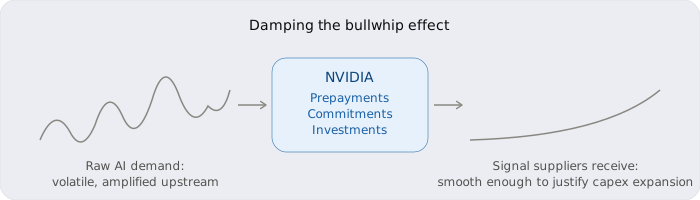
Nvidia's spending in prepayments, commitments, and investments absorbs those swings until suppliers gain the confidence to expand. Ibiden will not break ground on a new substrate plant because orders spiked last quarter. It breaks ground when somebody puts money down against the years it takes to bring that plant online, which is what fronting half the cost of the expansion does. The signal reaching the suppliers has to be smoother than the demand that produced it, or nothing gets built at all. The profitability concern is legitimate. If AI demand fizzles out like the reservations and delivery orders for the Beggar's chicken, then every prepayment becomes the straws and clay my uncle had bought.
The lesson at Golden Wok was that the bullwhip cannot be survived alone. The other Huang wants artificial intelligence in everyone's lives, and he's willing to stack up all five layers of the AI cake to do so. Every prepayment and equity check makes someone else sign onto the bet, from the chatbot all the way down to the glass yarn. Money flowing upstream commits Ibiden to pour concrete; money flowing downstream gives a startup the balance sheet to sign for compute. The spending is what keeps every layer committed and building long enough to outlast the whip.