Demystifying the Semiconductor Value Chain: High Bandwidth Memory (HBM)
The Memory Wall
It's twelve o'clock, noon. You're pulled onto the line at In-N-Out, and the lunch rush just hit. Orders are stacking up faster than you can build them. Somehow, every ingredient you need is locked in a freezer out in the parking lot. Not in the kitchen. Not in the back. Past the cars lined up at the drive-through. Every burger sends you sprinting across the lot for patties, lettuce, pickles, and tomatoes. By the time one is done, three more are waiting.

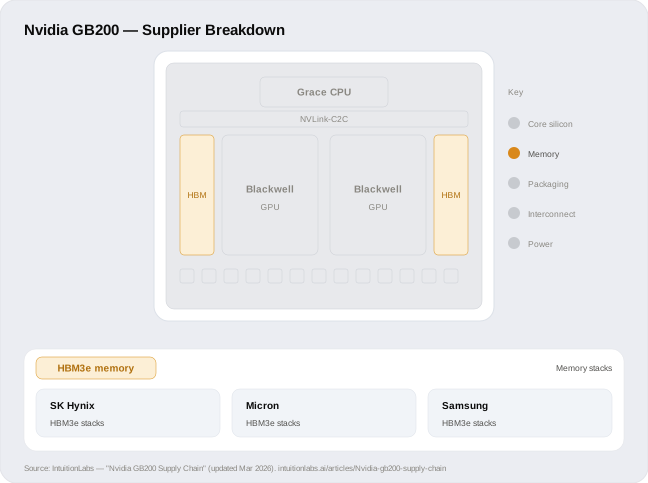
This is the challenge GPUs face when serving AI models with a traditional memory setup. Running faster won't help you keep up with the hungry customers piling up at the counter. We have to bring the freezer inside the store. Better yet, we can stack ten freezers right next to the grill and rig high-speed conveyor belts that drop ingredients to your hands the instant you reach out. Those stacked freezers are the high-bandwidth memory (HBM) modules, sitting on each side of the GPU:
The HBM Qualification
Memory chips undergo extensive testing by the manufacturer, but those tests primarily verify that the chip meets its specifications as an individual component. The real test to become approved for the GB200 platform is passing NVIDIA's System-in-Package (SiP) qualification, where they mount the HBM stacks next to a real GPU and simulate the In-N-Out lunch rush by running AI workloads at full speed.
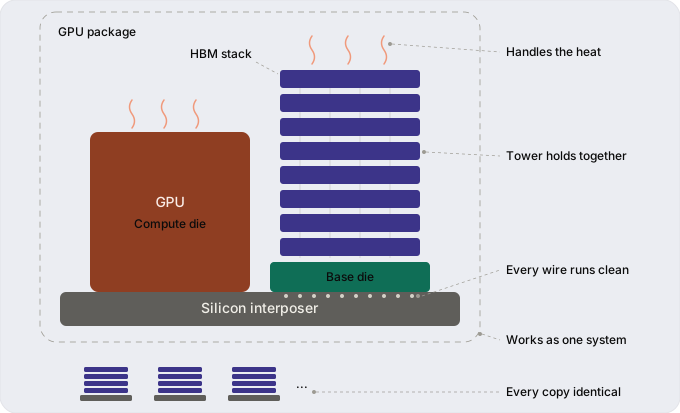
Running workloads with the GPU and memory chips packaged together stress tests three problems that solo bench tests cannot:
Thermal Coupling
Moving the freezers inside solved our memory wall problem, but now its inches from a roaring grill. In the real package, a GPU pushing hundreds of watts sits millimeters from memory that degrades as it heats up. Stacks that were fine on their own now have trouble keeping the ingredients fresh with the grill firing so close.
Thermal Throttling
Heat doesn't just spoil the ingredients, it also slows down the conveyor belts. When the memory stacks run hot, they throttle themselves to avoid damage; the blazing-fast delivery that justified stacking them next to the GPU in the first place quietly drops off. A stack that advertised full bandwidth on the bench may only sustain a fraction of it during the lunch rush.
Power Integrity
Power is the other trap. Alone on the test bench, each freezer gets its own outlet. In Nvidia's kitchen, the grill shares a single panel with the ten freezers. When they all draw power at once, the voltage sags and equipment that ran flawlessly in isolation starts to glitch.
Only after surviving the lunch rush inside NVIDIA's testing kitchen does a supplier's HBM get certified. The bar is brutally high. To this day, only three companies in the world have passed the requirments: SK Hynix, Samsung, and Micron. Even they have spent months, sometimes over a year, stuck in qualification before getting the green light.
The Memory Turnaround
Passing NVIDIA's HBM qualification has become the defining milestone for memory makers in the AI era. HBM demand has fueled massive rallies in all three HBM suppliers, and Wall Street now treats the trio as an oligopoly.
It's easy to forget how bad things were just three years ago. After the COVID-era surge in consumer electronics ended, the memory industry crashed into one of its worst downturns ever. SK Hynix and Micron were massively in the red; Samsung's chip division bled almost 15 trillion won. Memory was dubbed by Wall Street as a brutal commodity business plagued by identical products, price wars, and profits that evaporated every cycle.
In just a few years, high-bandwidth memory has fundamentally rewritten the economics of memory. Instead of competing as a commodity on the spot market, it's a specialized product sold under long-term contracts. HBM commands several times the price per bit of conventional DRAM, and winning NVIDIA's approval has become the single most valuable ticket in semiconductors.

No company illustrates the memory turnaround better than SK Hynix. After losing 8 trillion won in 2023, SK Hynix made a huge bet on HBM and became the first to pass NVIDIA's qualification. Its head start has translated into numbers that would have been unthinkable at the bottom of the downturn:
- Sold out through 2026. Every bit of DRAM, NAND, and HBM capacity through 2026 is already committed, much of it to NVIDIA.
- The most profitable quarter in semiconductor manufacturing history. Operating profit rose 405% year-over-year at a 72% operating margin — higher than NVIDIA's own 65%.
- Samsung, dethroned. In June, SK Hynix became South Korea's most valuable listed company, ending Samsung's 26-year reign at the top, with a market cap around $1.35 trillion.